Dating in the Time of #BlackLivesMatter

This is a repost from Racism Review. I am reposting my pieces from that platform to this blog due to the fact that the Racism Review blog is no longer active. Unfortunately, the post does not survive on the Wayback Machine via the Internet Archive, so the only available version will remain here on my personal blog with a few updates. The text of this piece was originally published on February 24, 2016.

Kerry Anne and Michael Gordon join a Black Lives Matter protest taking place alongside their wedding ceremony at The Logan hotel in Philadelphia on June 6, 2020.
Dr. Kerry Anne Perkins and Michael Gordon join a Black Lives Matter protest taking place alongside their wedding ceremony at The Logan hotel in Philadelphia on June 6, 2020. SOURCE: Linda McQueen—Linda McQueen Photography

When I started my dissertation research a year ago, I had not considered what impact the widespread media coverage of #BlackLivesMatter as a movement and rallying cry might have on my respondents. With my research, I intended to explore the online dating experiences of women who identify as multiracial here in Texas; what I have found has been a complex mobilization of Black Lives Matter as a metric of racial progressiveness. In 2016, it has become clear that the increased media attention being paid to the Black Lives Matter (BLM) movement is shaping a particular orientation toward, and conversation around, race and racism in the United States. As scholar Khury Petersen-Smith notes, the movement has “shattered what remained of the notion of a ‘post-racial’ America.” More specifically, my work has found that BLM has impacted individual-level relationships, creating a framework within which people are able to evaluate and “vet” their dating partners, especially amidst claims that society is more “progressive” and that the atrocities we have witnessed are “not about race.” 

As every good social scientist knows, words mean things. The language around, and produced by, movements like BLM – particularly in regards to discourses of race, racial inequality, state-sanctioned violence, and racism – has influenced the ways in which the multiracial women in my study discuss race, racism, and inequality in the context of their intimate relationships. Several women have described using their own stances on the issues BLM addresses as a means of selecting potential dating partners. This finding suggests that BLM and other widespread social justice movements are having significant impacts on how people are navigating racial politics on an interpersonal level. This is particularly pertinent during a time where U.S. media and popular culture is especially focused on issues of racism and state-sanctioned violence.  

Thus, Black Lives Matter provides multiracial women with a means of framing their commentary on racism, racial inequality, and violence. Often, these women describe trying to find a “middle ground” in which to exist politically, so as to not fall within the so-called “extremes.” This middle ground calls to mind the notion of mixed-race people being a “bridge” between communities. The “middle ground” also suggests that to be on the extremes is to identify too closely with blackness or to not be “beyond” race. Thus, many women expressed contradictions over the course of their interviews; for several women the tensions around race and racism are issues of “diversity” and something that these women perceive black people to be “ethnocentric” about. It is telling that the multiracial women who believe that the concerns of BLM are solely concerns for black people are women who are not of black descent. However, women of myriad mixed racial backgrounds – including those who are not part black – noted that the issues the movement highlights are concerns for us all.  

Alternatively, the women concerned with the so-called “appropriate” behavior of those interacting with the police rather than the inequality inherent in police violence rely on counter-Black Lives Matter narratives. They suggest that if someone is “acting stupid,” then an officer can only assume they are “dangerous and on drugs.” As social scientists have demonstrated for decades, overwhelmingly, the people who are assumed to be dangerous and on drugs are people of color. Virtually every woman who indicated that those killed by police are somehow responsible also relied on some “liberal” talking points, suggesting that officers “not go for the kill shot right away” or that “we need better training.” However, these women also used anti-black logic, which suggests that those killed by police are the deserving aggressors. Virtually all the women I interviewed who opposed BLM utilized the “some bad apples” discourse to suggest that these instances of police brutality are isolated incidents. This logic enabled several women to suggest that the movement is being overly sensitive and that the wrongdoing is on “both sides.”  

In terms of dating, women who consider potential dating partners’ views on issues of race and racism were invested in finding someone capable of making informed commentary. White masculinity in particular has a specific meaning in this political climate. Some multiracial women expect white men they date to have a certain racial literacy – the racial socialization and antiracist training that defends against and counters racism – and would not consider dating (white) men who are not at least marginally versed in anti-racist discourse and logics. This, however, is not necessarily a requirement for all potential partners, as several women indicated that they assume that men of color will just “get” that racism exists. So, white men are expected to provide proof that they “get it,” much of which is proven through how they engage with discourses around race and racism. Several women described pulling up videos of police assaults – such as the now infamous pool party in McKinney, TX – or referencing other news stories during dates in order to see how men would react.  

While it may not be surprising that women are excluding partners that they do not view as compatible, it is notable that several women indicated that “what’s going on” in the U.S. did not seem to matter much until about two years ago, correlating with the rise in Black Lives Matter demonstrations and news coverage. Public discourses impact our everyday lives, particularly the highly racialized, classed, and sexualized process of dating. We should be concerned for not only how people are responding to BLM and other related social movements, but also how people are implementing racial rhetoric in their everyday lives. As the mixed-race women in my research illustrate, the dating practices of Americans have the unfortunate potential to continue to reproduce much of the polarizing and unequal racial politics, as well as inherently unequal social structures, that have made Black Lives Matter and its like necessary in the first place. 

Modern Romance and the Glaring Absence of Race

This is a repost from Racism Review. I am reposting my pieces from that platform to this blog due to the fact that the Racism Review blog is no longer active. While the post survives in part on the Wayback Machine via the Internet Archive, it will also remain here on my personal blog with a few updates. The text of this piece was originally published on November 7, 2015.

Race is at the center of how we construct and act on our notions of desire, but you wouldn’t know that from reading Modern Romance, a unique collaboration between a sociologist and a comedian.

In collaboration with sociologist Eric Klinenberg, Aziz Ansari wrote Modern Romance, a book that explores “dating in the digital age.” Addressing the contemporary dynamics of romantic relationships – which are often mediated through various forms of technology (cell phones, online dating websites, etc.) – a major draw of Ansari’s New York Times best-selling book is that it seems to explain why young people are so “awful” about dating more traditionally and therefore, are not good at getting married.

Ansari, a comedian by trade, has established himself as someone who makes (albeit marginally) insightful observations about inequality, particularly when it comes to race, as with his new Netflix series Master of None.

In fact, Ansari notes that racism in Hollywood – specifically the problematic representation of Indian and other South Asian characters – was a central motivator for his creation of Master of None, as no one else would have offered him this role:

When they cast these shows, they’re like, ‘We already have our minority guy or our minority girl.’ There would never be two Indian people in one show. With Asian people, there can be one, but there can’t be two. Black people, there can be two, but there can’t be three because then it becomes a black show. Gay people, there can be two; women, there can be two; but Asian people, Indian people, there can be one but there can’t be two. Look, if you’re a minority actor, no one would have wrote this show for you… Every other show is still white people.

This astuteness around issues of race, racism, and representation are what drew me to Ansari’s book on dating this summer.

Modern Romance: Ansari, Aziz, Klinenberg, Eric: 9780143109259: Amazon.com:  Books

The book, however, is deeply flawed when it comes to any form of analysis of race. Considering Ansari’s awareness around issues of race in his comedy, I found the glaring absence of race in this book extremely disappointing. How one can write about “modern” romance and not note the role that race plays in terms of who is or is not deemed attractive is actually quite mind-boggling.

Modern Romance assumes a consistency of dating experience across race that is problematic. Assuming that people of color have had the same experiences as, or with, white people with online dating is critically irresponsible and is contradicted by the research. White millenials in particular have proven time and time again they are not as progressive as they are assumed to be, including in who they choose to date (or exclude from dating).

Even best-selling author and OKCupid co-founder Christian Rudder notes the continued role of racism in the chances of finding a partner online in his book Dataclysm and on the blog OKTrends. He reiterated this fact again during a Q&A at the 2015 meeting of the American Sociological Association in Chicago that I attended. When Helen Fisher of Match.com suggested that online dating had wiped out prejudice, he was quick to correct that misperception. Given the widely known and easily available data on race and online dating, the disappearing of race from Modern Romance’s analysis is all the more curious. This colorblind approach does little to help us understand contemporary intimacies that begin online and does even less to advance sociological understanding of modern romance.

Ansari does not mention the racial or class identities of the daters except for two Indian American men in a focus group. Thus, the text allows heterosexual middle class whiteness to masquerade as “universal.” This is particularly evident when Ansari and Klinenberg discuss the dynamics of traditional means of meeting potential dating partners with some residents of a New York City retirement home.

As the older informants in their book relate how they met their partners in their apartment buildings or in their neighborhoods, the book conveniently avoids noting how segregation and the white habitus were at play in terms of determining who people had access to decades ago and at present. When Ansari attempts to explicitly address race, it is treated as a cute joke. Ansari notes that he would have had a “hard time” trying to date in the 1950s due to being “brown” but he doesn’t go beyond that. Xenophobia, racism, and a variety of structural and legal inequalities also go without mention (Loving v. Virginia, for example) in Ansari’s brief commentary on his prospects in the time “before technology took over.”  It’s unclear what motivates this gaping lack of critical analysis other than a desire to maintain the levity of the book and, possibly, to avoid the “messiness” of race for Ansari’s predominantly white “progressive” audience.

More disturbingly, however, the book does an excellent job of perpetuating racist stereotypes. The author(s) herald the fact that they did not just rely on focus group and interview data from the States; they also talked with people in Buenos Aires, Argentina, Paris, France, Tokyo, Japan, and Doha, Qatar. Yet, the “international perspectives” chapter focuses mainly on contrasting Japan, Argentina, and the U.S.

In a problematic set of metaphors, the Japanese – particularly the men – are referred to as “herbivores” in contrast to the “rib eye-eating maniacs” of Argentina. This distinction perpetuates Western understandings of the sexuality of Asian and Latino men. There is a lengthy history of fetishizing the virility and “hot bloodedness” of Latino men while denigrating the lack of these qualities in Asian men in the United States, a dynamic that is well-documented in studies of interracial marriages (see NemutoSteinbugler or Frankenberg). These stereotypes inform not only dating and marriage dynamics in the U.S., but serve as motivation for phenomena such as sex tourism. Further, recent sociological studies have led to a focus in the media around the racist preferences of online daters, specifically the lesser prospects of black women and Asian men.

There may be nothing “new” about the relationships between race, sex, and romance, but if we truly want to understand “modern” romance, researchers (and comedians) must work to avoid strengthening colorblind logics.

The Problem with Saying ALL Lives Matter

This is a repost from Racism Review. I am reposting my pieces from that platform to this blog due to the fact that the Racism Review blog is no longer active. While the post survives in part on the Wayback Machine via the Internet Archive, it will also remain here on my personal blog with a few updates. The text of this piece was originally published on May 20, 2015.

17 Family Of Tony Robinson Holds Press Conference At Site Of Police Fatal  Shooting Photos & High Res Pictures - Getty Images
Turin Carter he uncle of 19-year-old Tony Robinson, speaks to the media outside the home where his nephew was killed on March 9, 2015 in Madison, Wisconsin. Source: Scott Olson/Getty Images

“We don’t want to stop at just “black lives matter” because all lives matter. To look at Tony and say that he’s just black, based just off his appearance, is something we’re basing legislation that is 150 years old almost now – less than that. I’m referring to Plessy v. Ferguson, okay. Terrell is a mixture of everything. You can’t look at him and say he’s black. He’s black, white, he’s a mixture of everything because we all have our own complex heritage.” ~ Turin Carter, uncle of 19-year-old Tony Robinson, shot and killed by police

In the wake of a Mother’s Day that seemed to weigh more heavily than those of past years, I found myself returning to comments made in March of this year. When I first read of Turin Carter’s remarks on the fatal shooting of his nephew, Tony Terrell Robinson, Jr., I found myself equally saddened and frustrated. Yet, in the midst of my empathy, I found Carter’s heart-wrenching admission that Tony was a “misfit” and that he “just wanted to be loved” to be troubling.

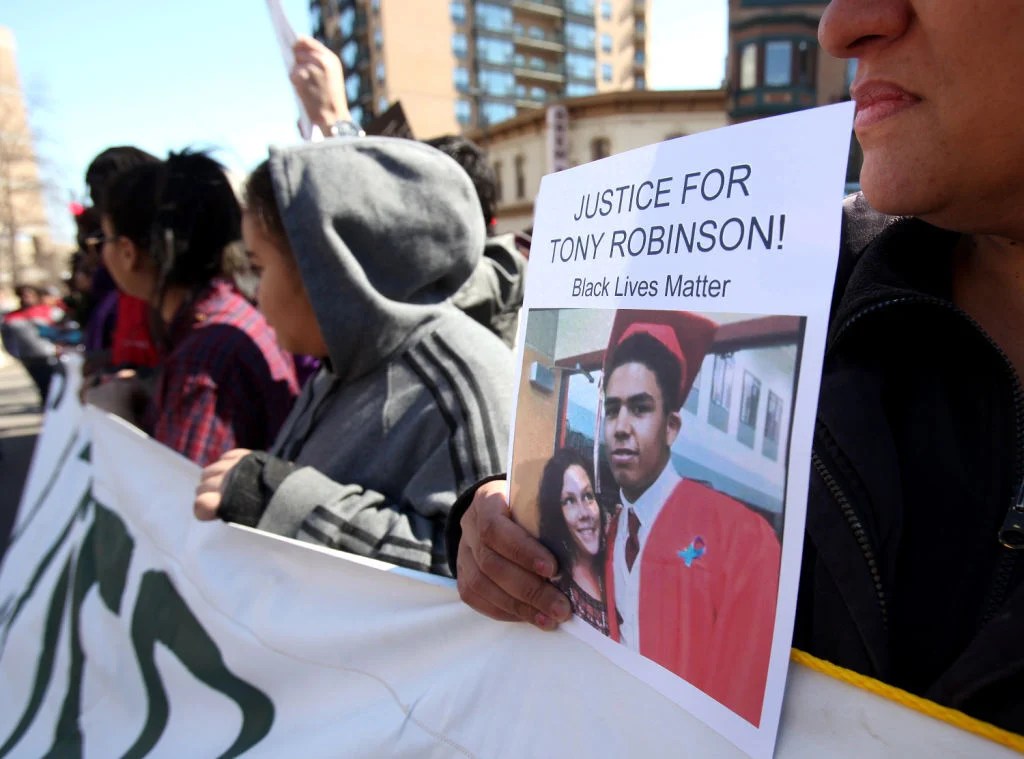
Students protest the officer-involved shooting death of Tony Robinson Jr. in 2015. Source: MIKE DeVRIES

Virtually all American blacks are considered to be of “mixed” descent due to rape during slavery and a long history of interracial relationships, but Carter’s comments suggest that to talk about black lives mattering is to not be wholly inclusive of his nephew’s life.

The narrative of mixed-race children who can find no place because they are so ambiguous perpetuates the stereotype of the “tragic mulatto” who can never find love.  Alongside Robinson’s “need to be loved,” Carter repeatedly insists in his drafted statement – and in response to the questions that follow – that Tony is not “just” black. And yet, he describes Tony as one of several “black children” of a white mother. The emphasis on Tony’s mixedness and how it caused him a particular kind of emotional duress – even while acknowledging that Tony was a “black child” – reifies Tony’s differentness from other young black men who have been killed by police.

As Carter notes, “we don’t want to stop at just black lives matter because all lives matter.” As well-intentioned as I’m sure his comment was, it reinforces the “all lives matter” rebuttal that pushes back against the #blacklivesmatter movement and serves as a means of erasure. Insisting that “all” lives matter suggests that a focus on black lives – which are being disproportionately snuffed out – is not inclusive of the various ways that state-sanctioned violence impacts our society. The push for recognition of “all lives” implies a universality of experience, rooted in a universal humanism that is less anti-racist and more colorblind. To say that black lives matter is not to say that other lives do not.

Black Lives Matter protests: What you need to know
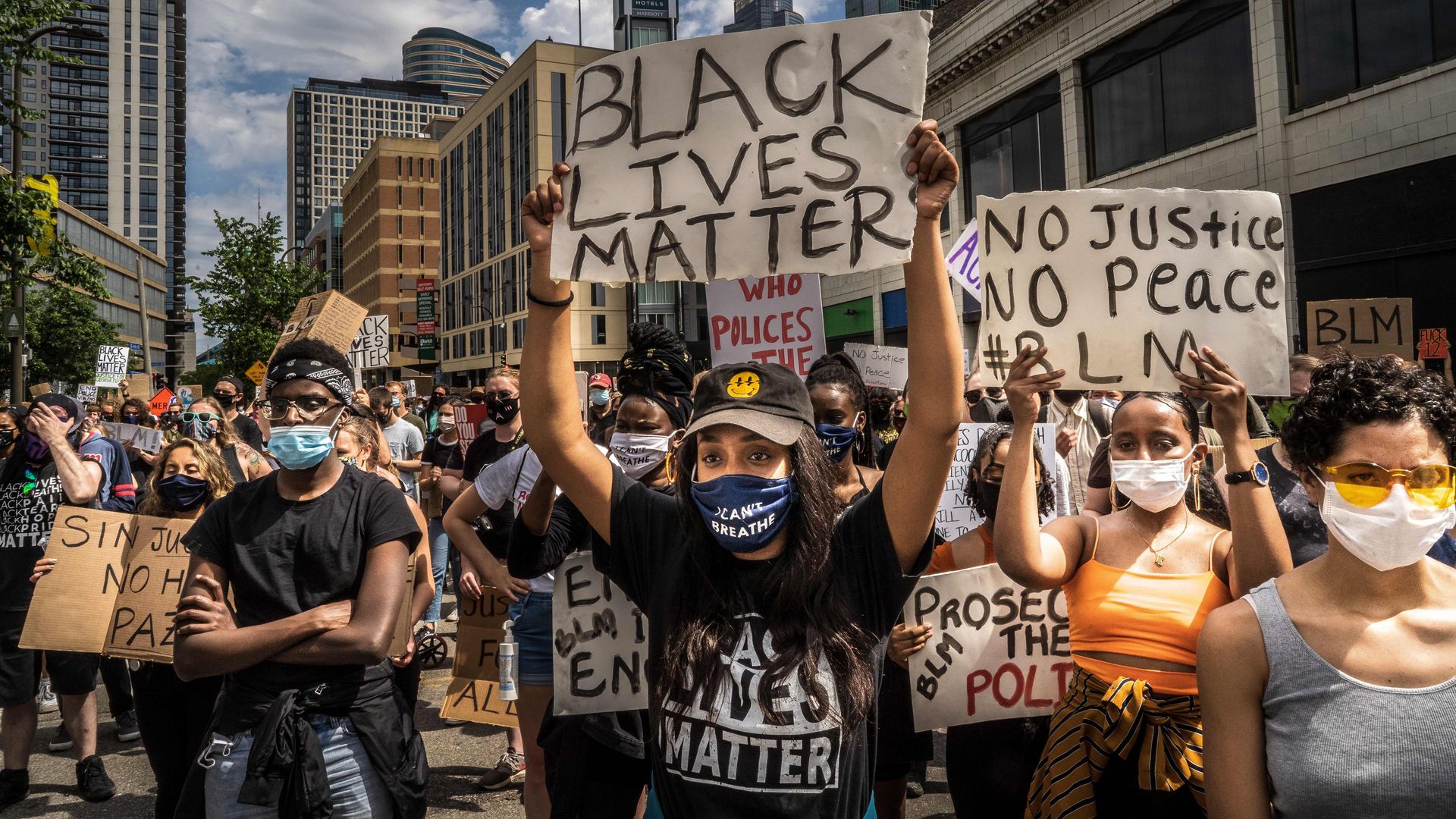
Protesters outside the Minneapolis 1st Police precinct during a demonstration against police brutality and racism in Minneapolis, Minnesota, in 2020. Photo: Kerem Yucel/AFP via Getty Images

Carter also said that Tony’s “racial ambiguity reinforces the fact that America’s racial lines are completely and 100 percent blurred…We are all multiple races and we each have our own complex heritage. There’s no way you can look at me, there’s no way you can look at Tony or any of my nephews, and determine 100 percent what we are, in terms of our heritage and our ethnicity.” Despite the assertion that America’s racial lines are 100 percent blurred (not necessarily) and that Carter and his nephews can not be easily racially categorized (perhaps), these young men are viewed by the state as men of color, particularly ones who are deemed threatening and less innocent. Carter notes this himself when he refers to his nephews as “black children of a white mother.” However, it is this emphasis on the “children of a white mother” that causes me concern. When multiracial families insist that racial lines are blurred, they are working to validate their own experiences. This is why many parents of mixed-race children insist that their children are “both” (see, for example, pieces by Jacobs and by Kich in Racially Mixed People in America; and, Rockemore, et al., in Mixed Messages).

By placing the focus on “a white mother grieving her child,” we might think that it is white motherhood that is under attack rather than black and brown bodies.

The “he’s not black, he’s mixed” argument seems like it would be one that could work in the family’s favor; by painting Tony Robinson as “a mixture of everything” and “not just black,” Carter’s comments assert a connection to whiteness as a strategy of redemption in the midst of media demonization. Though it can be argued that these comments also attempt to diminish the value of whiteness, this ignores how multiracialism has a history of complicity in anti-blackness (for more on this, see Sexton).

Andrea Irwin , the mother of Tony Robinson, marches in the streets... News  Photo - Getty Images
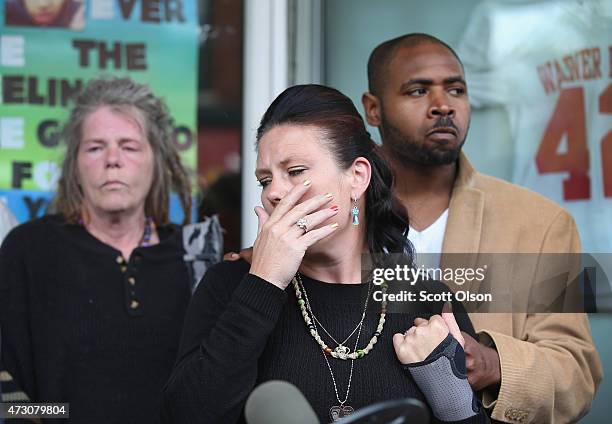
Andrea Irwin, the mother of Tony Robinson, fights back tears at a press conference held by the Tony’s family near where he was shot following the Dane County District Attorney’s announcement of no charges for the officer (Source: Scott Olson /Getty)

By playing up Robinson’s whiteness, his tragic mulatto-ness, the family’s comments engage in distancing from blackness and, thus, from danger. To have the deservedly emotional white mother and white grandmother standing behind Carter as he makes his statement bolsters this whiteness and therefore, our need as Americans to be concerned with Robinson’s death. The murder of a young black man – who was already a tragic tale due to being a racial “outcast” – is seemingly more tragic now that he has a white mother to grieve him. A problematic logic is further supported through Carter’s comments on having “multiple races” and “complex heritage.” To be “more than” implies colorblindness – that the issues of state violence and police brutality are beyond race.

So, it’s not surprising that media outlets picked up on the “beyond race” thread in Carter’s comments as it strengthens the colorblind logic that race “cannot be seen,” promoting universal sameness. The “all lives matter” rebuttal relies on colorblind racism; to point out that race informs the disparities we see in police-related assaults is to “be” racist. Carter’s statement that he and his nephews are beyond “just” black provides mainstream media with a post-racial soundbite that can be used to further undermine the insistence that black lives matter.

It is tragic that Andrea Irwin, Robinson’s mother, was reminded that her son was viewed as black when the state exercised violence against him. I imagine her realization was akin to Jane Lazarre’s realization that her whiteness would not protect her son from being strapped down to a hospital bed and treated as inherently dangerous. Though I had wondered if the family’s assertion of Robinson’s whiteness might lead to an indictment of the officer who killed him, as we have seen, that is not the case.

Not only was it ruled that Officer Kenny “legally” used deadly force, he was praised for his approach in the situation that ended in a 19 year-old black teen’s death. As Carter insightfully states, his nephew’s death “highlights a universal problem with law enforcement and how it’s procedures have been carried out…specifically, as it pertains to the systematic targeting of young black males.”

With no justice for Tony Robinson, it is my fear that no mother’s grief – including Andrea Irwin’s — transcends the deeply entrenched belief that black lives do not matter.

[Black] bodies are not monuments.

It has been 24 hours or so since I first came across an opinion piece from a poet and academic proclaiming her body a “monument to the Confederacy.”

I have continued to dwell on her opening line: “I have rape-colored skin.” Her choice to call her body and skin a monument to the “legacy of the Confederacy.” The fervid responses from colleagues and people I admire calling the piece powerful while others call(ed) it deeply uncomfortable, upsetting, gut-churning. My own reactions of dismay and alarm and later, confusion, disrupted my sleep and have felt like a burden taking up space in the back of my mind all day.

What does it mean to call a body a monument — specifically a Black body — particularly a monument to the dehumanization, brutalization, and exploitation of our Black predecessors? What does it mean to offer up how that trauma and horror of colonization, of chattel slavery, of Jim Crow is embedded and embodied and how that “legacy” should not just be acknowledged but also lends legitimacy to Black people’s calls to tear down actual monuments to the Confederacy? Who is the target audience when one says they have “rape-colored skin” (as though only light-skinned Black people were produced from these assaults) or that they have “rebel-grey blue blood coursing [their] veins” (as though the racial ideologies of our Black ancestors’ rapists, abusers, exploiters, oppressors are genetic and inherited via blood)? Who are you trying to shock and awe, to convince to join in the destruction of these mounds of stone and steel meant to symbolize the indomitable spirit of the white South?

Many of my favorite writers have thought long and hard about what it means for bodies to be sites of contestation. That the existence of people we in the United States currently identify as “multiracial” or “mixed-race” pre-dates the so-called Loving Generation. That their bodies symbolize(d) histories of conquest, increases in property value, or even contamination of whiteness seems to undergird Williams’ argument of “body as monument.” We — as a settler colonial society — certainly need to think about the ways who we are today and the lives we live, the things we believe and value, are a product of the relations between people who understood themselves as supreme human beings (entitled to the land and bodies of other people) and those they deemed racial “others” who are/were understood not just as lesser but quite literally inhuman. We need to contend with what it means for people to have involuntary “familial” connections borne out of assault and abuse, for those histories to inform present-day iterations of economic, political, and social assault and abuse.

If Black bodies are not monuments to the Confederacy, what are they? Are they not monuments to Black people’s perseverance, love, community, creativity, imagination? To hope? Why frame our bodies as sites of pain, biologically tied to white “ancestors”? Why make any biological arguments about non-white people at all, knowing how fraught that is?

I remain unconvinced that reducing race to the body, to the genes that make up our DNA (and when combined in particular ways may favor certain characteristics), is the way to motivate white people to see that Black people, and really any colonized peoples, are human and deserving of respect. That our bodies and the harm bodies like ours have experienced in the past will inspire white people to end their desire to leave up physical places of honor for people who were so invested in owning other human beings that they seceded and fought a losing war in order to protect their “property.” But it is not only the legacy of the Confederacy that must be destroyed but that of the entire United States — Confederates weren’t the only ones holding people in bondage or working to keep Black people from gaining any semblance of access to basic human rights. Even the leaders who are lauded as the “fathers” of this country kept Black people as property, believed many of the same things their Confederate brethren believed (thus why we have so many Confederate statues or buildings named for its leaders in states that weren’t even in the Confederacy). I am as appalled at Williams’ framing of her biological connection to the Confederacy and the Ku Klux Klan as I am by the defense of Ulysses Grant as “one of the good ones” because he emancipated the singular enslaved African that he inherited through marriage.

Rooting moral logics in being for or against the Confederacy alone leaves a lot to be desired.

There is no such thing as “one of the good ones” when you owned other people and participated in the massacre of indigenous peoples and the theft of their land. There is no such thing as being genetically white or Black, because to be white or Black is about social and political relation. There is no such thing as an ancestral relation between us and the people who forcibly took land, bodily autonomy, rights, cultural practice, and family from our Black predecessors simply because there are “blood ties” or shared chromosomal markers. We are within our rights to demand the removal and eradication of statues, of named buildings, of flags, of songs, of awards, of all lingering traces of the Confederacy not because of shared history or biology…but because we wish to imagine and bring forth a world that rejects the valorization of people and ideologies that diminish the humanity of anyone. Destroying the vestiges of the Confederacy should not be the end of this fight. Everything this country was built on must go, too.