Dating in the Time of #BlackLivesMatter

This is a repost from Racism Review. I am reposting my pieces from that platform to this blog due to the fact that the Racism Review blog is no longer active. Unfortunately, the post does not survive on the Wayback Machine via the Internet Archive, so the only available version will remain here on my personal blog with a few updates. The text of this piece was originally published on February 24, 2016.

Kerry Anne and Michael Gordon join a Black Lives Matter protest taking place alongside their wedding ceremony at The Logan hotel in Philadelphia on June 6, 2020.
Dr. Kerry Anne Perkins and Michael Gordon join a Black Lives Matter protest taking place alongside their wedding ceremony at The Logan hotel in Philadelphia on June 6, 2020. SOURCE: Linda McQueen—Linda McQueen Photography

When I started my dissertation research a year ago, I had not considered what impact the widespread media coverage of #BlackLivesMatter as a movement and rallying cry might have on my respondents. With my research, I intended to explore the online dating experiences of women who identify as multiracial here in Texas; what I have found has been a complex mobilization of Black Lives Matter as a metric of racial progressiveness. In 2016, it has become clear that the increased media attention being paid to the Black Lives Matter (BLM) movement is shaping a particular orientation toward, and conversation around, race and racism in the United States. As scholar Khury Petersen-Smith notes, the movement has “shattered what remained of the notion of a ‘post-racial’ America.” More specifically, my work has found that BLM has impacted individual-level relationships, creating a framework within which people are able to evaluate and “vet” their dating partners, especially amidst claims that society is more “progressive” and that the atrocities we have witnessed are “not about race.” 

As every good social scientist knows, words mean things. The language around, and produced by, movements like BLM – particularly in regards to discourses of race, racial inequality, state-sanctioned violence, and racism – has influenced the ways in which the multiracial women in my study discuss race, racism, and inequality in the context of their intimate relationships. Several women have described using their own stances on the issues BLM addresses as a means of selecting potential dating partners. This finding suggests that BLM and other widespread social justice movements are having significant impacts on how people are navigating racial politics on an interpersonal level. This is particularly pertinent during a time where U.S. media and popular culture is especially focused on issues of racism and state-sanctioned violence.  

Thus, Black Lives Matter provides multiracial women with a means of framing their commentary on racism, racial inequality, and violence. Often, these women describe trying to find a “middle ground” in which to exist politically, so as to not fall within the so-called “extremes.” This middle ground calls to mind the notion of mixed-race people being a “bridge” between communities. The “middle ground” also suggests that to be on the extremes is to identify too closely with blackness or to not be “beyond” race. Thus, many women expressed contradictions over the course of their interviews; for several women the tensions around race and racism are issues of “diversity” and something that these women perceive black people to be “ethnocentric” about. It is telling that the multiracial women who believe that the concerns of BLM are solely concerns for black people are women who are not of black descent. However, women of myriad mixed racial backgrounds – including those who are not part black – noted that the issues the movement highlights are concerns for us all.  

Alternatively, the women concerned with the so-called “appropriate” behavior of those interacting with the police rather than the inequality inherent in police violence rely on counter-Black Lives Matter narratives. They suggest that if someone is “acting stupid,” then an officer can only assume they are “dangerous and on drugs.” As social scientists have demonstrated for decades, overwhelmingly, the people who are assumed to be dangerous and on drugs are people of color. Virtually every woman who indicated that those killed by police are somehow responsible also relied on some “liberal” talking points, suggesting that officers “not go for the kill shot right away” or that “we need better training.” However, these women also used anti-black logic, which suggests that those killed by police are the deserving aggressors. Virtually all the women I interviewed who opposed BLM utilized the “some bad apples” discourse to suggest that these instances of police brutality are isolated incidents. This logic enabled several women to suggest that the movement is being overly sensitive and that the wrongdoing is on “both sides.”  

In terms of dating, women who consider potential dating partners’ views on issues of race and racism were invested in finding someone capable of making informed commentary. White masculinity in particular has a specific meaning in this political climate. Some multiracial women expect white men they date to have a certain racial literacy – the racial socialization and antiracist training that defends against and counters racism – and would not consider dating (white) men who are not at least marginally versed in anti-racist discourse and logics. This, however, is not necessarily a requirement for all potential partners, as several women indicated that they assume that men of color will just “get” that racism exists. So, white men are expected to provide proof that they “get it,” much of which is proven through how they engage with discourses around race and racism. Several women described pulling up videos of police assaults – such as the now infamous pool party in McKinney, TX – or referencing other news stories during dates in order to see how men would react.  

While it may not be surprising that women are excluding partners that they do not view as compatible, it is notable that several women indicated that “what’s going on” in the U.S. did not seem to matter much until about two years ago, correlating with the rise in Black Lives Matter demonstrations and news coverage. Public discourses impact our everyday lives, particularly the highly racialized, classed, and sexualized process of dating. We should be concerned for not only how people are responding to BLM and other related social movements, but also how people are implementing racial rhetoric in their everyday lives. As the mixed-race women in my research illustrate, the dating practices of Americans have the unfortunate potential to continue to reproduce much of the polarizing and unequal racial politics, as well as inherently unequal social structures, that have made Black Lives Matter and its like necessary in the first place. 

The Problem with Saying ALL Lives Matter

This is a repost from Racism Review. I am reposting my pieces from that platform to this blog due to the fact that the Racism Review blog is no longer active. While the post survives in part on the Wayback Machine via the Internet Archive, it will also remain here on my personal blog with a few updates. The text of this piece was originally published on May 20, 2015.

17 Family Of Tony Robinson Holds Press Conference At Site Of Police Fatal  Shooting Photos & High Res Pictures - Getty Images
Turin Carter he uncle of 19-year-old Tony Robinson, speaks to the media outside the home where his nephew was killed on March 9, 2015 in Madison, Wisconsin. Source: Scott Olson/Getty Images

“We don’t want to stop at just “black lives matter” because all lives matter. To look at Tony and say that he’s just black, based just off his appearance, is something we’re basing legislation that is 150 years old almost now – less than that. I’m referring to Plessy v. Ferguson, okay. Terrell is a mixture of everything. You can’t look at him and say he’s black. He’s black, white, he’s a mixture of everything because we all have our own complex heritage.” ~ Turin Carter, uncle of 19-year-old Tony Robinson, shot and killed by police

In the wake of a Mother’s Day that seemed to weigh more heavily than those of past years, I found myself returning to comments made in March of this year. When I first read of Turin Carter’s remarks on the fatal shooting of his nephew, Tony Terrell Robinson, Jr., I found myself equally saddened and frustrated. Yet, in the midst of my empathy, I found Carter’s heart-wrenching admission that Tony was a “misfit” and that he “just wanted to be loved” to be troubling.

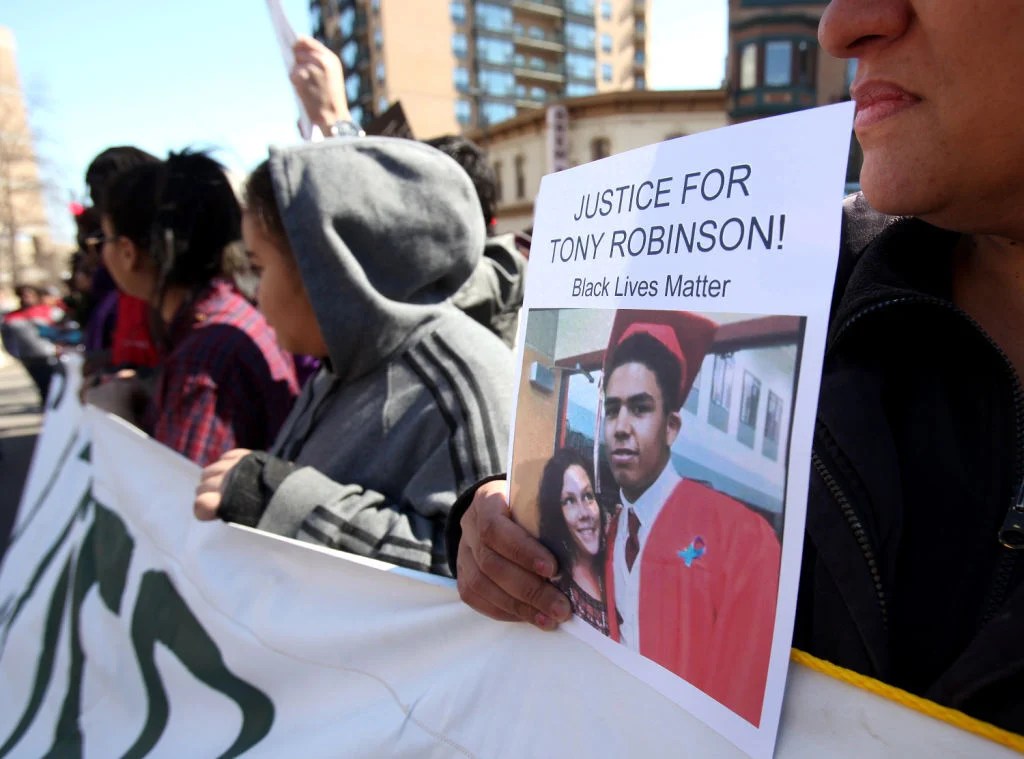
Students protest the officer-involved shooting death of Tony Robinson Jr. in 2015. Source: MIKE DeVRIES

Virtually all American blacks are considered to be of “mixed” descent due to rape during slavery and a long history of interracial relationships, but Carter’s comments suggest that to talk about black lives mattering is to not be wholly inclusive of his nephew’s life.

The narrative of mixed-race children who can find no place because they are so ambiguous perpetuates the stereotype of the “tragic mulatto” who can never find love.  Alongside Robinson’s “need to be loved,” Carter repeatedly insists in his drafted statement – and in response to the questions that follow – that Tony is not “just” black. And yet, he describes Tony as one of several “black children” of a white mother. The emphasis on Tony’s mixedness and how it caused him a particular kind of emotional duress – even while acknowledging that Tony was a “black child” – reifies Tony’s differentness from other young black men who have been killed by police.

As Carter notes, “we don’t want to stop at just black lives matter because all lives matter.” As well-intentioned as I’m sure his comment was, it reinforces the “all lives matter” rebuttal that pushes back against the #blacklivesmatter movement and serves as a means of erasure. Insisting that “all” lives matter suggests that a focus on black lives – which are being disproportionately snuffed out – is not inclusive of the various ways that state-sanctioned violence impacts our society. The push for recognition of “all lives” implies a universality of experience, rooted in a universal humanism that is less anti-racist and more colorblind. To say that black lives matter is not to say that other lives do not.

Black Lives Matter protests: What you need to know
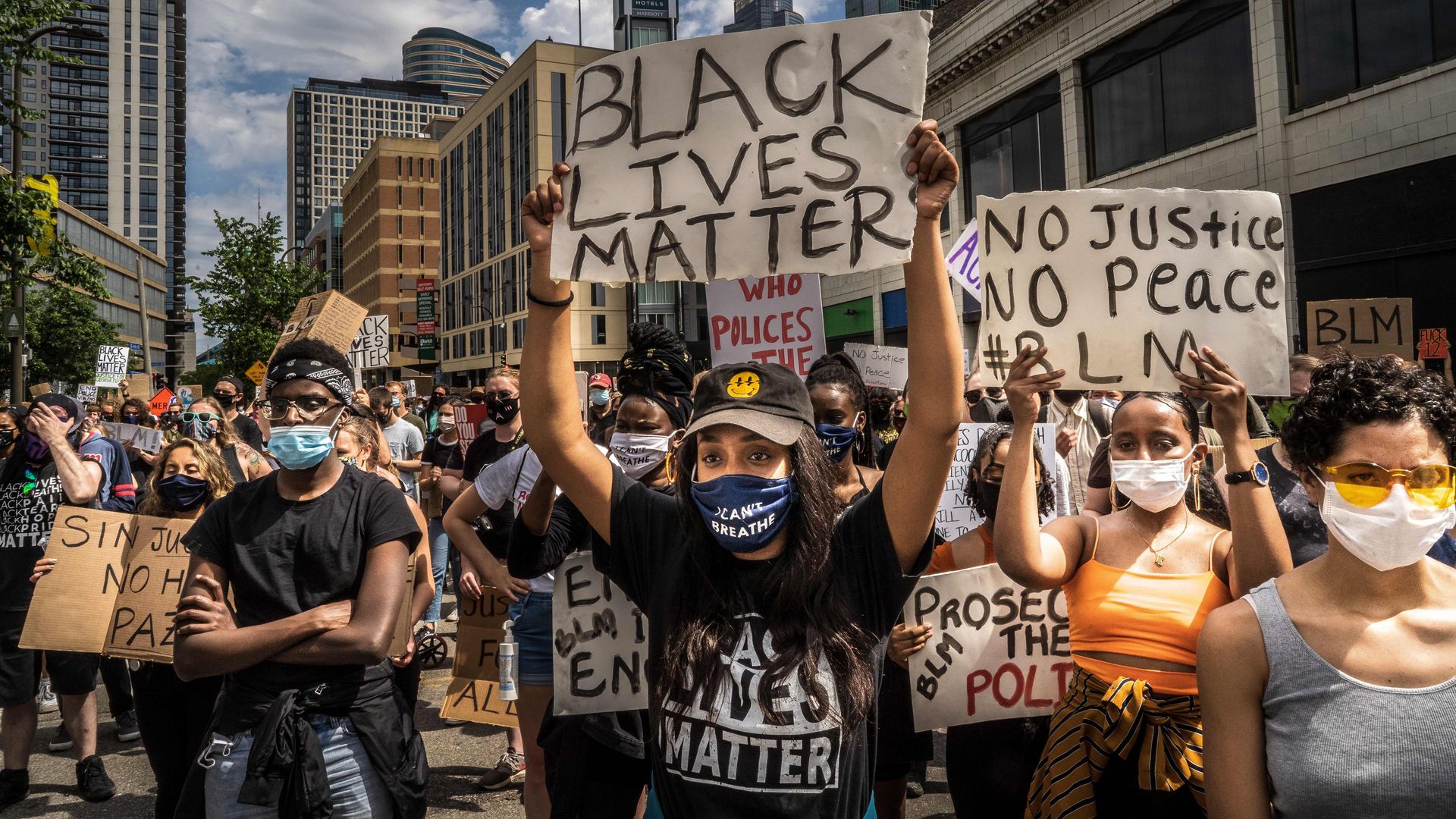
Protesters outside the Minneapolis 1st Police precinct during a demonstration against police brutality and racism in Minneapolis, Minnesota, in 2020. Photo: Kerem Yucel/AFP via Getty Images

Carter also said that Tony’s “racial ambiguity reinforces the fact that America’s racial lines are completely and 100 percent blurred…We are all multiple races and we each have our own complex heritage. There’s no way you can look at me, there’s no way you can look at Tony or any of my nephews, and determine 100 percent what we are, in terms of our heritage and our ethnicity.” Despite the assertion that America’s racial lines are 100 percent blurred (not necessarily) and that Carter and his nephews can not be easily racially categorized (perhaps), these young men are viewed by the state as men of color, particularly ones who are deemed threatening and less innocent. Carter notes this himself when he refers to his nephews as “black children of a white mother.” However, it is this emphasis on the “children of a white mother” that causes me concern. When multiracial families insist that racial lines are blurred, they are working to validate their own experiences. This is why many parents of mixed-race children insist that their children are “both” (see, for example, pieces by Jacobs and by Kich in Racially Mixed People in America; and, Rockemore, et al., in Mixed Messages).

By placing the focus on “a white mother grieving her child,” we might think that it is white motherhood that is under attack rather than black and brown bodies.

The “he’s not black, he’s mixed” argument seems like it would be one that could work in the family’s favor; by painting Tony Robinson as “a mixture of everything” and “not just black,” Carter’s comments assert a connection to whiteness as a strategy of redemption in the midst of media demonization. Though it can be argued that these comments also attempt to diminish the value of whiteness, this ignores how multiracialism has a history of complicity in anti-blackness (for more on this, see Sexton).

Andrea Irwin , the mother of Tony Robinson, marches in the streets... News  Photo - Getty Images
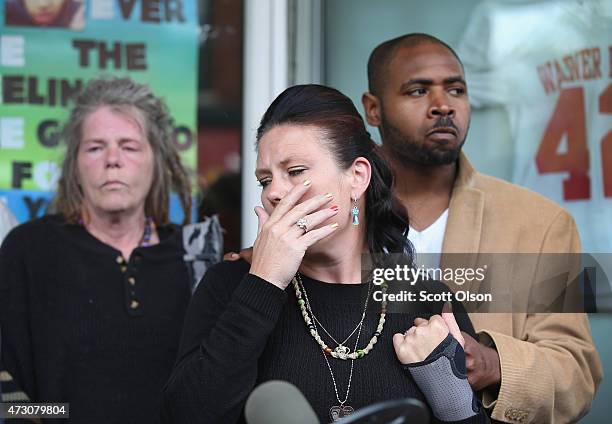
Andrea Irwin, the mother of Tony Robinson, fights back tears at a press conference held by the Tony’s family near where he was shot following the Dane County District Attorney’s announcement of no charges for the officer (Source: Scott Olson /Getty)

By playing up Robinson’s whiteness, his tragic mulatto-ness, the family’s comments engage in distancing from blackness and, thus, from danger. To have the deservedly emotional white mother and white grandmother standing behind Carter as he makes his statement bolsters this whiteness and therefore, our need as Americans to be concerned with Robinson’s death. The murder of a young black man – who was already a tragic tale due to being a racial “outcast” – is seemingly more tragic now that he has a white mother to grieve him. A problematic logic is further supported through Carter’s comments on having “multiple races” and “complex heritage.” To be “more than” implies colorblindness – that the issues of state violence and police brutality are beyond race.

So, it’s not surprising that media outlets picked up on the “beyond race” thread in Carter’s comments as it strengthens the colorblind logic that race “cannot be seen,” promoting universal sameness. The “all lives matter” rebuttal relies on colorblind racism; to point out that race informs the disparities we see in police-related assaults is to “be” racist. Carter’s statement that he and his nephews are beyond “just” black provides mainstream media with a post-racial soundbite that can be used to further undermine the insistence that black lives matter.

It is tragic that Andrea Irwin, Robinson’s mother, was reminded that her son was viewed as black when the state exercised violence against him. I imagine her realization was akin to Jane Lazarre’s realization that her whiteness would not protect her son from being strapped down to a hospital bed and treated as inherently dangerous. Though I had wondered if the family’s assertion of Robinson’s whiteness might lead to an indictment of the officer who killed him, as we have seen, that is not the case.

Not only was it ruled that Officer Kenny “legally” used deadly force, he was praised for his approach in the situation that ended in a 19 year-old black teen’s death. As Carter insightfully states, his nephew’s death “highlights a universal problem with law enforcement and how it’s procedures have been carried out…specifically, as it pertains to the systematic targeting of young black males.”

With no justice for Tony Robinson, it is my fear that no mother’s grief – including Andrea Irwin’s — transcends the deeply entrenched belief that black lives do not matter.